
Capture status is separate
Complete, Incomplete and Unavailable describe licence-assignment capture separately from rendered evidence state.
Evidence & Coverage
This page documents the evidence contract behind the simpler customer-facing claims elsewhere on the site. Source provenance, availability, completeness, Coverage, rendered evidence state and licence-assignment capture status remain separate so missing evidence never becomes a clean conclusion.
Release-status boundary
Selected observed-zero, unavailable-source and scanner-failure paths have automated-test and controlled runtime evidence in a reviewed Salesforce environment. Running-user sharing, CRUD, field-level security and environment compatibility remain separate validation questions for the release build and target environment. Public package installation is not yet claimed.
Evidence detail levels
Top Issues, Balanced and Everything change what safe detail is retained, displayed, compared and exported; the selected level does not redefine the assessed source scope. Everything is the deepest supported level, not exhaustive or unlimited.
Licence-assignment retention
Top Issues retains no licence-assignment rows or assignment-summary rows; the omitted assignment detail is Not retained at this evidence level. Balanced retains holding summaries only; individual assignment identities are Not captured. Everything performs bounded assignment capture for Package Licences, Permission Set Licences and Salesforce User Licences, retaining up to 1,000 rows per family. The theoretical maximum is 3,000 retained rows per scan across those three families, not an organisation total. Actual safe capture can be lower because Salesforce transaction and DML headroom must be preserved.
Complete, Incomplete and Unavailable describe licence-assignment capture separately from rendered evidence state.
An incomplete capture can contain fewer rows than expected or zero rows. It must not be shown as Complete, and an unknown expected count remains unknown.
Capacity totals and holding summaries remain distinct from capped assignment identities and from the selected evidence detail level.
Evidence boundary
When an evidence source cannot be assessed, Security Observatory preserves that limitation explicitly. It does not convert unavailable evidence into a zero count, clean state or unsupported assurance claim.
Evidence terminology
The rendered state is selected according to the limiting evidence dimension. Partial is a completeness qualifier, not a separate state. Coverage remains a separate axis for supporting-framework review. A retained state is the point-in-time rendered state stored with a scan.
Read this before drawing conclusions
SBS boundary
SBS is an independent project, not a Salesforce product or a Fortmilo benchmark, and it is not endorsed or supported by Salesforce. Control references are version-bound pointers to retained evidence. They are not statements that a control is satisfied, compliant, certified, secure or passed. Where human judgement is required or a source is unsupported, Manual Required or Not Covered remains explicit as applicable.
SBS material is attributed under CC BY-SA 4.0; Security Observatory identifies the referenced source/version and any mapping modifications.
Coverage type describes how far available evidence can assess the mapped question. It is neither confidence nor the selected evidence detail level.
Coverage tiles, including Partial Evidence, remain separate from control-outcome tiles and filters.
SBS remains independent from Salesforce and Fortmilo; the mapping records source, version and modification context.
Export controls
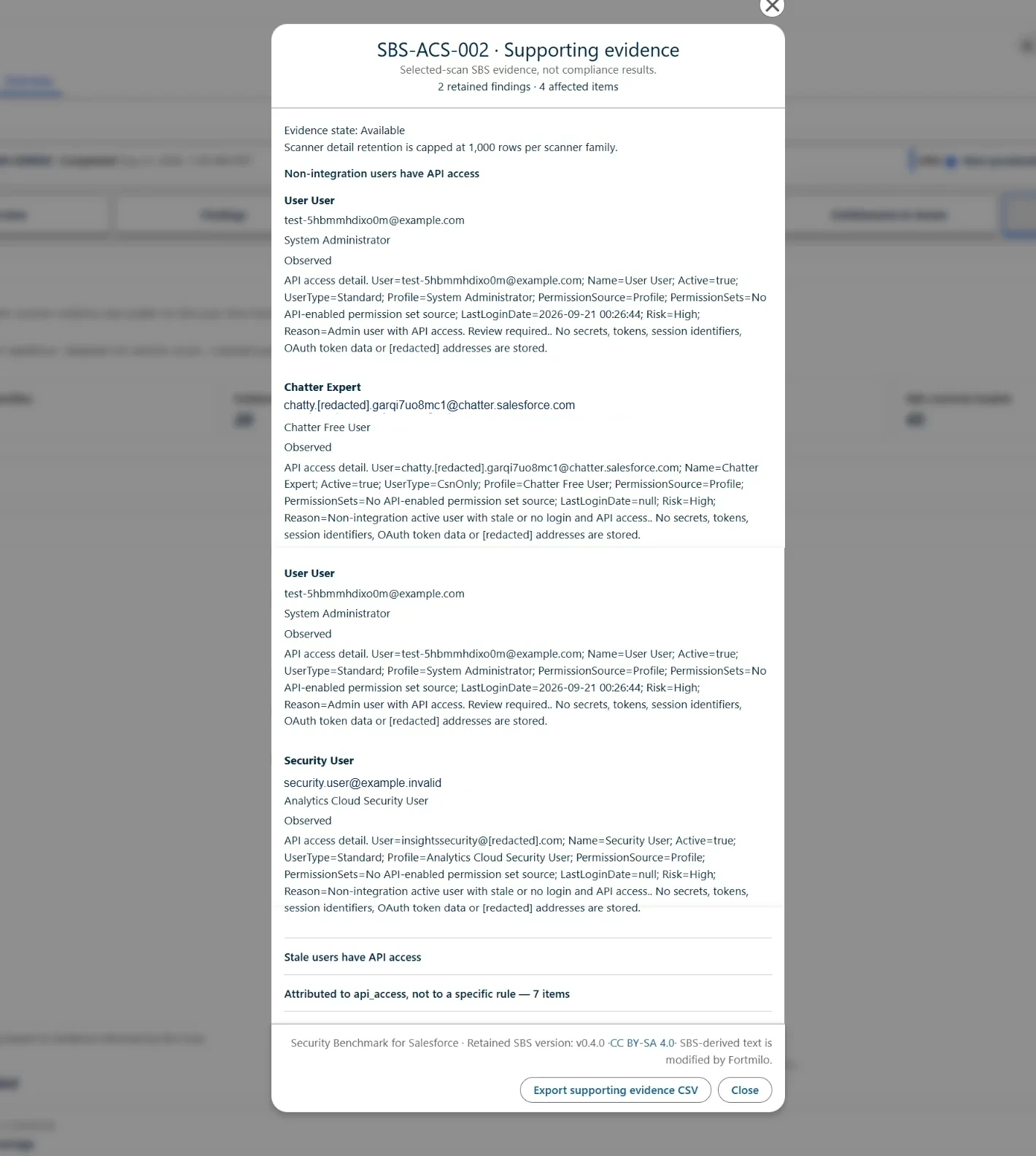
There is no universal retained-evidence CSV schema. Each evidence surface exports an allow-listed subset of display fields, and the browser download creates a separate boundary outside Salesforce.
The asset and governance CSV does not export the complete governance record. Review the governed record in Salesforce for supported ownership, purpose and review context.
In the reviewed JavaScript export helper, every header and cell is quoted, embedded quotes are doubled, and tabs, carriage returns and line feeds are flattened to spaces. If a cell begins with =, +, - or @, an apostrophe is prefixed. This is bounded to the reviewed helper paths and enumerated trigger characters.
Helper-backed exports sanitise prohibited sensitive-value labels and IP literals. Observatory-retained and exported evidence contains no token values, session IDs, secrets, certificate bodies or raw IPs.
Retained-history boundary
Free V1 retains 1–10 completed scans. Review remains bounded to the same source Salesforce organisation and like evidence levels; a later terminology change does not silently rewrite retained historical evidence.
Top Issues, Balanced and Everything describe retained detail and must not be treated as interchangeable.
Current defaults are Developer Edition 1, Sandbox 3 and Production 3 retained completed scans.
A terminology-contract change does not by itself reinterpret evidence retained by an earlier scan.